Session 4: Campaigns, the press and the power of images
- What is the Resident Commissioner of Puerto Rico?
- Give one difference between Puerto Rico and Washington, D.C.
- Complete: ______ they are citizens, they cannot vote for president.
Answer key
- Puerto Rico's member of the House, elected for four years, who cannot vote on the final passage of bills.
- Washington, D.C. has three electors; Puerto Rico has none.
- Although / Even though
Objet d'étude : S'engager dans la presse et les médias : dessins, caricatures et photojournalisme
Question: Can images and the media inform voters without taking sides?
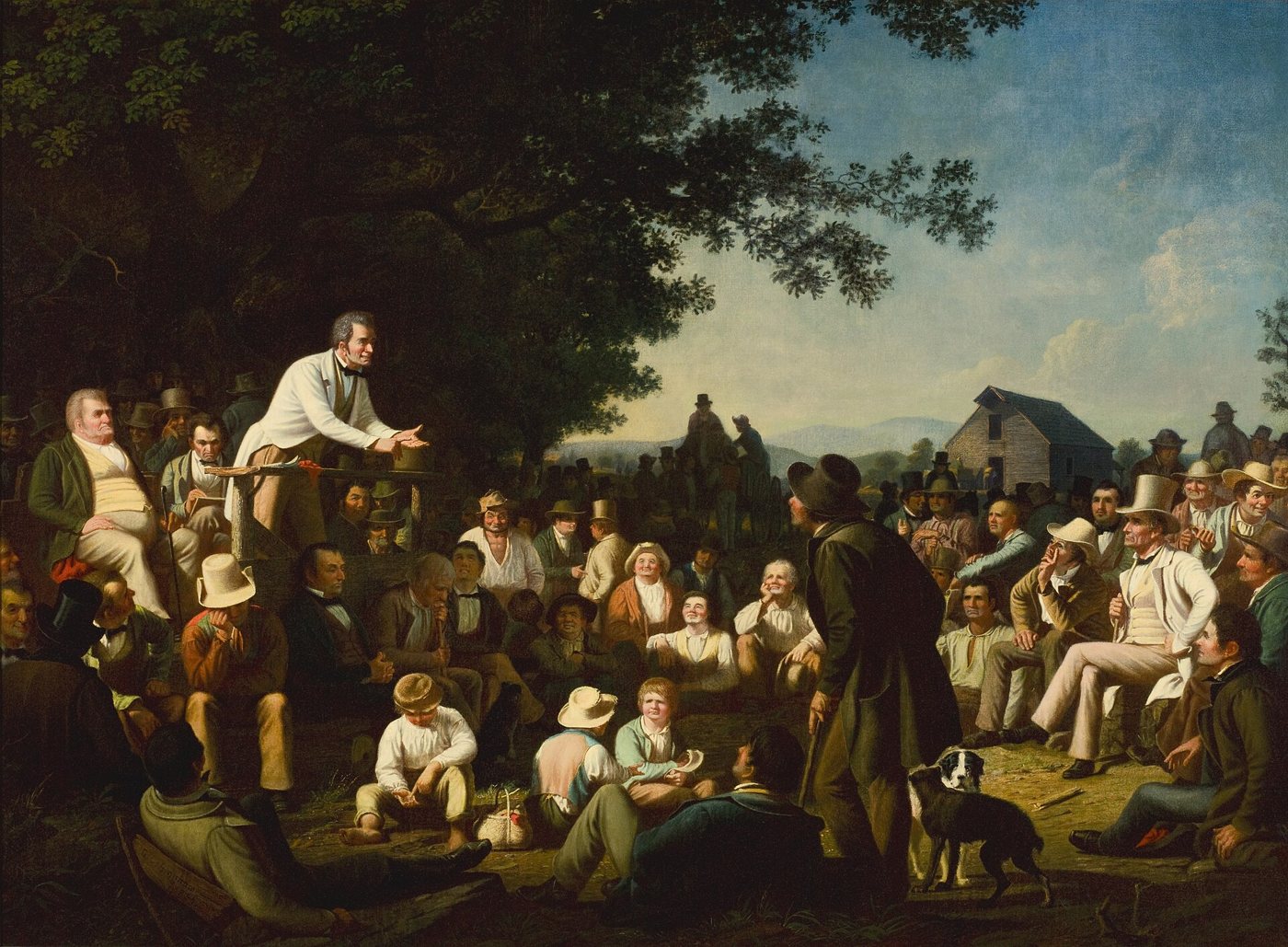
A painter who lost an election
Compréhension de l'écritStump Speaking is the first painting of Bingham's Election Series.
A candidate leans forward to make his points to a crowd of rural citizens. Behind him, his opponent sits with a tablet and takes notes for his turn.
In 1846, Bingham himself was a Whig Party candidate for the Missouri legislature. He won by three votes, but the election was contested and the seat was given to his opponent, Erasmus Darwin Sappington.
According to the Saint Louis Art Museum, Sappington is the speaker shown in the painting.
Bingham still wanted the painting to celebrate democratic elections for a national audience.
Understand
Compréhension de l'écrit- What is happening in the painting?
- What happened to Bingham in 1846?
- Who is the speaker, according to the museum?
- Is the painting a criticism or a celebration of elections? Justify.
- Find one sentence in the text that is a fact and one that is an interpretation.
Answer key
- A candidate gives a speech to a rural crowd; his opponent waits and takes notes.
- He won by three votes, but the election was contested and the seat was given to his opponent.
- Erasmus Darwin Sappington, his opponent.
- Both are possible: Bingham painted the man who took his seat (a personal comment), but he wanted to celebrate democracy for a national audience.
- Fact: In 1846, Bingham was a Whig Party candidate. Interpretation: Bingham intended the painting to celebrate democracy.
Your turn
Compréhension de l'écrit · Esprit critiqueInformation or opinion? Classify: 1. Polls closed at 7 p.m. in Georgia. 2. This candidate is the only one who really cares about you. 3. The House has 435 voting members. 4. A disastrous night for the party. 5. The results will be certified by each state. 6. Voters sent a clear message. Then rewrite two opinions as neutral information.
Key points
Information: 1, 3, 5. Opinion or interpretation: 2, 4, 6. Example of a neutral rewrite: 4. The party lost seats. 6. One party won more seats than the other.
Expanding your vocabulary
Lexique en lien avec les axes culturels · Médias et engagement| Word | Meaning | Example |
|---|---|---|
| a stump speech | the standard speech of a candidate on tour | He gave the same stump speech in ten towns. |
| to campaign, to canvass | to try to win votes, to visit voters | Volunteers canvassed door to door. |
| biased | not neutral | A biased article hides some facts. |
| to fact-check | to check that a statement is true | Journalists fact-check the candidates. |
| a soundbite | a short sentence made to be repeated | The debate was full of soundbites. |
| spin | a way of presenting facts to look good | Both parties put their own spin on the results. |
| to sway voters | to influence voters | Can a painting sway voters? |
| to heighten public awareness | to make people more conscious of an issue | The press heightens public awareness. |
Odd one out, then explain: 1. biased, neutral, one-sided, partisan. 2. canvass, campaign, fact-check, rally. 3. soundbite, slogan, catchphrase, ballot.
Answer key
- neutral (the others mean taking sides)
- fact-check (the others are about winning votes)
- ballot (the others are short sentences)
Grammar
Passer du discours direct au discours rapportéReported speech: say (that) / tell someone (that) / ask if, what, why. With a reporting verb in the past, go back one tense: present → past, will → would, past → past perfect. "I will win," he said. → He said (that) he would win. Questions: "Who won?" she asked. → She asked who had won.
- "I care about farmers," the candidate said. → The candidate said ______ .
- "We will lower taxes," they told voters. → They told voters ______ .
- "Did you vote?" the reporter asked me. → The reporter asked me ______ .
- "I won by three votes," Bingham said. → Bingham said ______ .
Answer key
- (that) he cared about farmers.
- (that) they would lower taxes.
- if I had voted.
- (that) he had won by three votes.
Production
Expression orale en continuSpeech: you are a candidate in Stump Speaking. Give a one-minute stump speech to the crowd. Then a classmate reports it in reported speech and says what is fact and what is opinion.
Key points
Check: a greeting, three promises, a call to vote; the report uses said, told, asked and goes back one tense; the classmate separates facts from promises and opinions.
Homework
Key points
Check: a source and a date; a justified answer (an information headline states a verifiable fact; an opinion headline uses judgement words such as disastrous, clear, historic).