Session 1: Reading a painting: The Verdict of the People
- Name the two main political parties in the United States.
- How often is the American president elected?
- What is Congress, and what are its two chambers?
- When did Americans vote in the midterms this year?
Answer key
- The Democratic Party and the Republican Party.
- Every four years; the next presidential election is in November 2028.
- The legislative branch, which makes the laws: the House of Representatives and the Senate.
- On Tuesday 3 November 2026.
Objet d'étude : L'art, les artistes et le pouvoir
Question: How does a painter show the power of the voters?
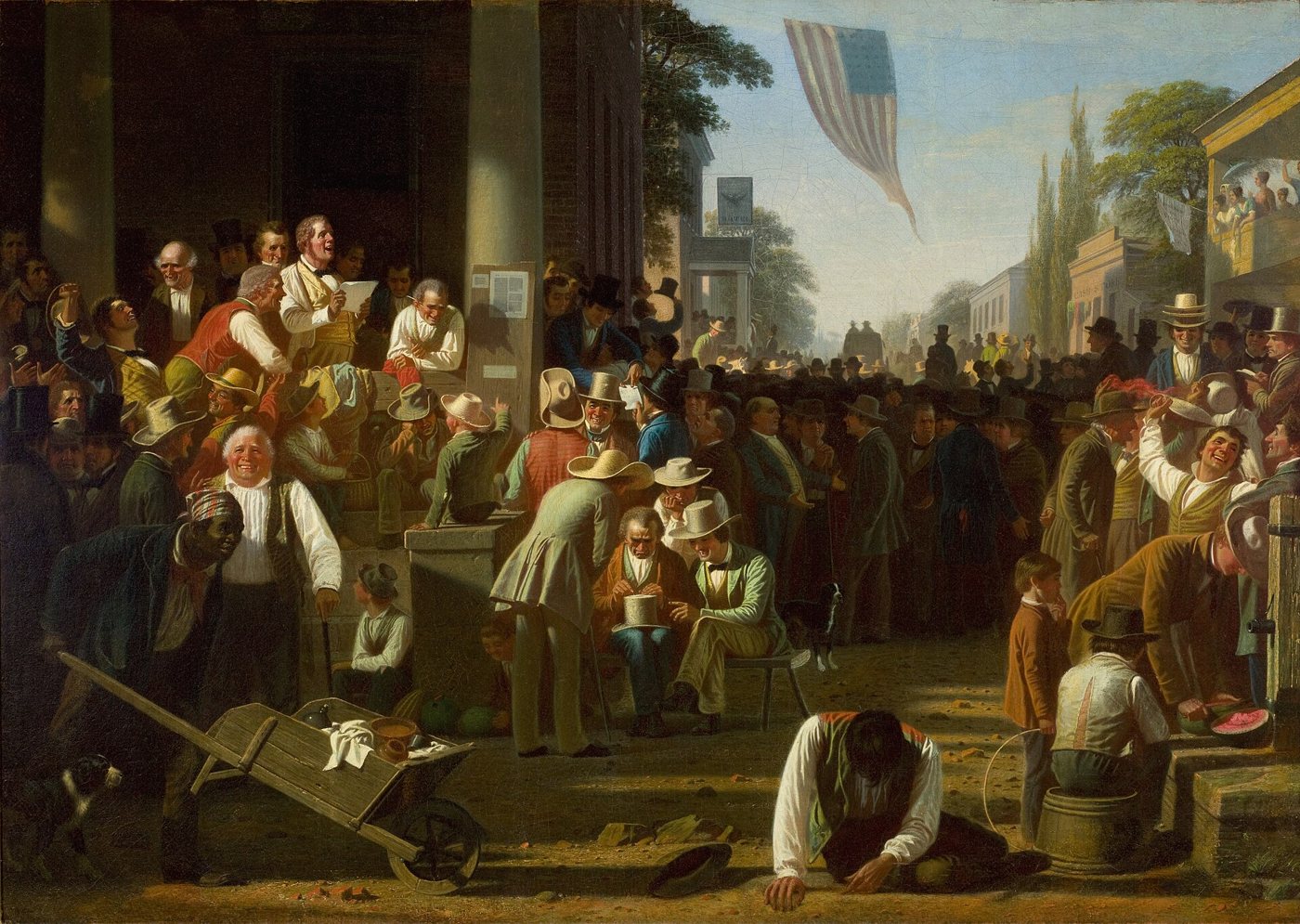
About the painting
Compréhension de l'écritGeorge Caleb Bingham (1811-1879) was a painter and a politician: he sat in the Missouri legislature.
Between 1853 and 1855, in Philadelphia, he painted three scenes of American democracy, known as the Election Series: Stump Speaking (the campaign), The County Election (the vote) and The Verdict of the People (the results).
In The Verdict of the People, a crowd gathers around a courthouse to hear the results of the vote. Farmers, labourers, merchants, children, politicians, immigrants and veterans are there.
Their reactions vary: some men are overjoyed, others are confused, argumentative or dejected.
According to the Saint Louis Art Museum, the women on the balcony and the African American man in the left foreground represent two groups who had no voice in government at the time.
Bingham exhibited the three paintings in 1860 and hoped to sell them to the Library Committee of Congress.
Sources: Saint Louis Art Museum, The Verdict of the People · Saint Louis Art Museum, Stump Speaking
Understand
Compréhension de l'écrit- Who painted The Verdict of the People, and when?
- What do the three paintings of the Election Series show, in order?
- What is the crowd waiting for?
- Which two groups had no voice in government at the time, according to the museum?
- Why is it interesting that Bingham was also a politician?
Answer key
- George Caleb Bingham, in 1854-1855, in Philadelphia.
- The campaign (Stump Speaking), the vote (The County Election), the results (The Verdict of the People).
- The results of the election, read on the steps of the courthouse.
- Women, shown on the balcony, and enslaved African Americans, represented by the man in the left foreground.
- He knew elections from the inside: his painting shows both his ideal of democracy and the noisy reality he had experienced.
Your turn
Expression orale en continuDescribe the painting for one minute. Say where things are (in the foreground, in the background, on the left, in the top right-hand corner), what people are doing, and what the painter wants to say about democracy.
Key points
Key points: in the foreground, men react to the results: one waves a handkerchief, one lies on the ground; on the left, men gather on the courthouse steps, where the results are read; in the background, a large flag; on the balcony, women watch. Message: the people decide, but not all the people could vote in the 1850s.
Expanding your vocabulary
Lexique en lien avec les axes culturels · Les représentations du pouvoir| Word | Meaning | Example |
|---|---|---|
| to depict, to portray | to show in a picture | Bingham depicts a crowd on election day. |
| in the foreground / background | at the front / at the back of the picture | In the foreground, a man waves a handkerchief. |
| symbolic of | that represents an idea | The flag is symbolic of the nation. |
| to convey a message | to communicate an idea | The painter conveys a message about democracy. |
| iconic | very famous and representative | It has become an iconic image of American elections. |
| an onlooker | a person who watches | The women on the balcony are onlookers. |
| dejected / elated | very sad / very happy | The losers look dejected; the winners are elated. |
| through a lens | from a particular point of view | Bingham sees elections through the lens of a politician. |
Match each word with its synonym: depict, elated, onlooker, convey, dejected. Synonyms: overjoyed, communicate, show, spectator, downcast.
Answer key
- depict: show
- elated: overjoyed
- onlooker: spectator
- convey: communicate
- dejected: downcast
Grammar
Situer dans l'espace · Les auxiliaires de modalitéTo describe a picture, use the present simple or the present be+ing with a place marker: In the foreground, a man is waving a handkerchief. To make deductions, use a modal: must (almost certain), might / may / could (possible), can't (almost impossible): The man on the steps must be reading the results. The man with the banner might be a supporter of the winner.
- The man on the ground ______ (be) very tired: he is lying down. (almost certain)
- The women on the balcony ______ (be) voters. (almost impossible)
- The man on the steps with a paper ______ (be) a local official. (possible)
- In the top left-hand corner, a flag ______ (fly).
- On the right, two men ______ (argue).
Answer key
- must be
- can't be (women could not vote in Missouri in the 1850s)
- might be / may be / could be
- is flying
- are arguing
Production
Expression écriteWrite a museum label (about 100 words) for The Verdict of the People: title, artist, date, what we see, and one sentence on the message.
Key points
Model: The Verdict of the People, George Caleb Bingham, 1854-1855. A crowd gathers in front of a courthouse in Missouri to hear the results of an election. In the foreground, men react: some cheer, some look dejected. On the balcony, women watch. They could not vote at the time. Bingham, a painter and a politician, depicts democracy as noisy but alive, and reminds us who was left out.
Homework
Key points
Check: a full reference (title, author, date), one place marker (in the foreground...), one modal (must, might, can't).