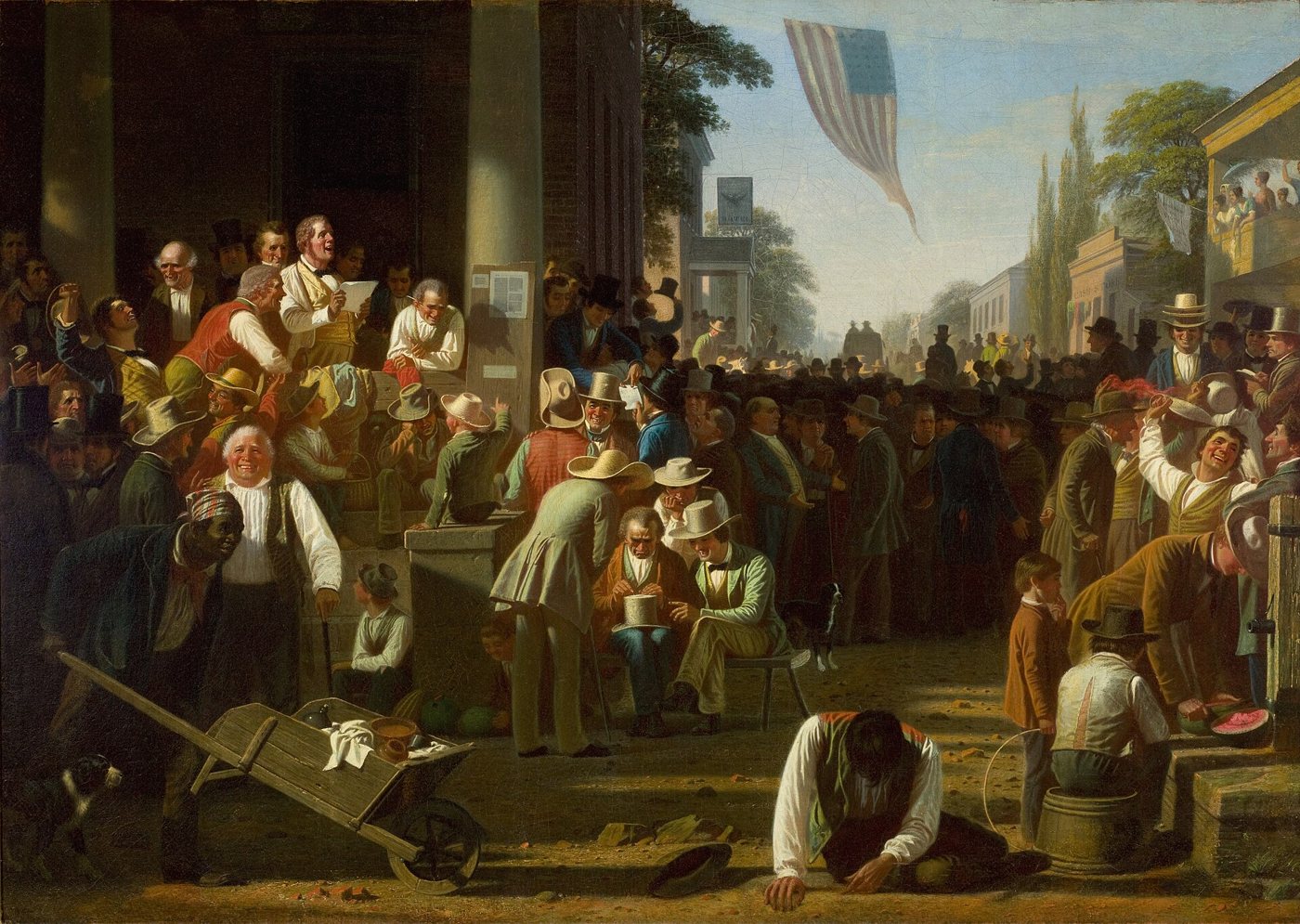
The Verdict of the People: US Elections, the 2026 Midterms and the Americas
Introduction
Why this sequence? On 3 November 2026, Americans elected a new Congress, halfway through President Trump's term. This sequence starts from a painting of 1854-1855, George Caleb Bingham's The Verdict of the People, and asks how elections give and limit power in the United States, who is represented, and why the whole continent follows the results.
Problem. How does the verdict of the people shape power in the United States, and beyond its borders?
Level. Première générale, LVA: B1, towards B1+.
Organisation. Seven sessions. Each one opens with a recap and ends with homework, with a grammar point and an Expanding your vocabulary grid. Answers are hidden: click to check. In session five, you find the results of 3 November 2026 yourselves on reliable websites: the sequence gives no result figures on purpose. Final task: a cross-border radio debate, or an opinion piece. An adapted version for dyslexic students follows the same sessions.
Real facts only. All facts come from official sources and museum records (Saint Louis Art Museum, National Archives, USAGov, the Clerk of the House, the Office of the Resident Commissioner, USTR), checked on 4 November 2026. See the sources.
Overview
| Session | Axes and object of study | Grammar |
|---|---|---|
| 1. Reading a painting: The Verdict of the People | Axe 3. Art et pouvoir · Axe 6. Les aires anglophones américaines L'art, les artistes et le pouvoir | Situer dans l'espace · Les auxiliaires de modalité |
| 2. Checks and balances: why the midterms matter | Axe 6. Les aires anglophones américaines Les institutions des États-Unis (contexte de l'axe 6) | La voix passive |
| 3. Who is represented? Puerto Rico and Washington, D.C. | Axe 6. Les aires anglophones américaines · Axe 2. Diversité et inclusion Porto Rico : le 51e état ? | Exprimer une opposition, une concession ou un contraste · Les comparatifs |
| 4. Campaigns, the press and the power of images | Axe 3. Art et pouvoir S'engager dans la presse et les médias : dessins, caricatures et photojournalisme | Passer du discours direct au discours rapporté |
| 5. The results: you find them | Axe 6. Les aires anglophones américaines Les élections de mi-mandat du 3 novembre 2026 | Effectuer des choix entre les temps · L'hypothèse par l'inversion |
| 6. Beyond the borders: the midterms and the Americas | Axe 6. Les aires anglophones américaines Le pôle d'attraction nord-américain | Le présent et le futur pour exprimer une hypothèse · Les auxiliaires de modalité |
| 7. Final task: a cross-border radio debate | Axe 6. Les aires anglophones américaines · Axe 3. Art et pouvoir Tâche finale | Connecteurs logiques |
Sessions
Session 1: Reading a painting: The Verdict of the PeopleHow does a painter show the power of the voters?Session 2: Checks and balances: why the midterms matterWhy do the midterms of 3 November 2026 matter, even without a presidential election?Session 3: Who is represented? Puerto Rico and Washington, D.C.Are all American citizens equally represented in Washington?Session 4: Campaigns, the press and the power of imagesCan images and the media inform voters without taking sides?Session 5: The results: you find themWho won the midterms of 3 November 2026, and what does it change for the president?Session 6: Beyond the borders: the midterms and the AmericasWhy do Canada, Mexico and the Caribbean follow American elections so closely?Session 7: Final task: a cross-border radio debateWhat does the verdict of the people of 3 November 2026 change, for the United States and its neighbours?Adapted version (dyslexia)Checked sources and image referencesRepères pour l'enseignant(e)
Programme. Programme d'anglais pour les classes de lycée général et technologique, classe de première, repères culturels LVA, LVB et LVC.
Axes. « Axe 6. Les aires anglophones américaines » (obligatoire), associé à « Axe 3. Art et pouvoir ». Le programme permet d'« en associer deux, reliés par une problématique commune, dans une même séquence ». La séance 3 croise aussi « Axe 2. Diversité et inclusion ».
Objets d'étude mobilisés. « Porto Rico : le 51e état ? » et « Le pôle d'attraction nord-américain » (axe 6) ; « L'art, les artistes et le pouvoir » et « S'engager dans la presse et les médias : dessins, caricatures et photojournalisme » (axe 3).
Niveau visé. Première, LVA : B1+ ; LVB : B1.
Grammaire (repères B1 / B1+). La voix passive ; passer du discours direct au discours rapporté ; effectuer des choix entre les temps ; le présent et le futur pour exprimer une hypothèse ; exprimer l'hypothèse par l'inversion du sujet ; exprimer une opposition, une concession ou un contraste ; les auxiliaires de modalité ; une gamme étendue de connecteurs logiques.
Résultats. Les élèves cherchent et saisissent eux-mêmes les résultats du 3 novembre 2026 (séance 5) : la séquence ne donne volontairement aucun chiffre de résultat.
Vidéos. Aucune vidéo n'est proposée : seules des sources écrites vérifiées sont utilisées.