Session 4: Campaigns, the press and the power of images
Recap check
- What is the Resident Commissioner of Puerto Rico?
- Give one difference between Puerto Rico and Washington, D.C.
- Complete: ______ they are citizens, they cannot vote for president.
Answer key
- Puerto Rico's member of the House, elected for four years, who cannot vote on the final passage of bills.
- Washington, D.C. has three electors; Puerto Rico has none.
- Although / Even though
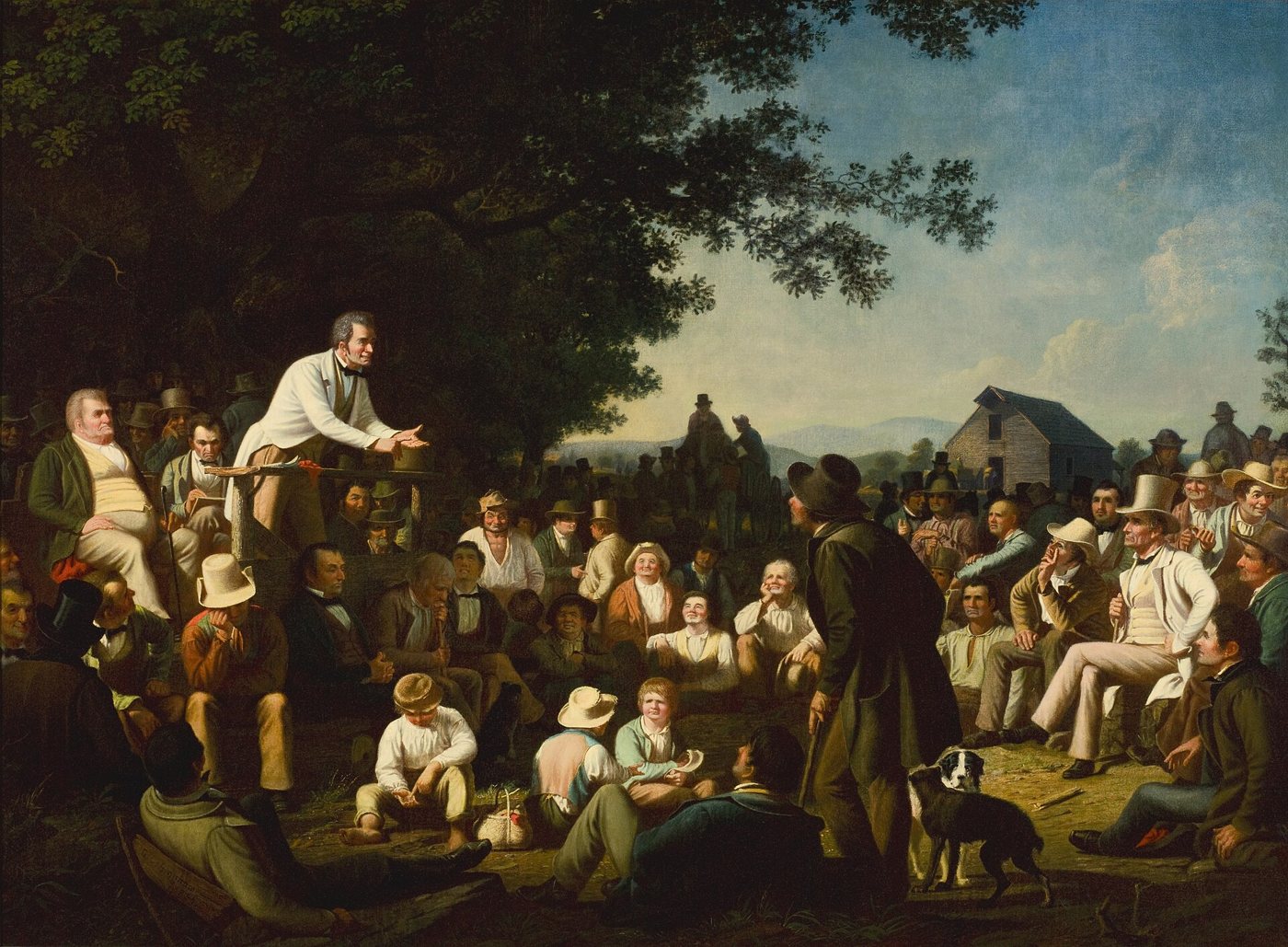
Look at the painting
Words to know
| Word | Meaning |
|---|---|
| a stump speech | the standard speech of a candidate on tour |
| to campaign, to canvass | to try to win votes, to visit voters |
| biased | not neutral |
| to fact-check | to check that a statement is true |
| a soundbite | a short sentence made to be repeated |
Read, one sentence per line
- Stump Speaking is the first painting of Bingham's Election Series.
- A candidate leans forward to make his points to a crowd of rural citizens. Behind him, his opponent sits with a tablet and takes notes for his turn.
- In 1846, Bingham himself was a Whig Party candidate for the Missouri legislature. He won by three votes, but the election was contested and the seat was given to his opponent, Erasmus Darwin Sappington.
- According to the Saint Louis Art Museum, Sappington is the speaker shown in the painting.
- Bingham still wanted the painting to celebrate democratic elections for a national audience.
Answer
- What is happening in the painting?
- What happened to Bingham in 1846?
- Who is the speaker, according to the museum?
Answer key
- A candidate gives a speech to a rural crowd; his opponent waits and takes notes.
- He won by three votes, but the election was contested and the seat was given to his opponent.
- Erasmus Darwin Sappington, his opponent.
Grammar
Reported speech: say (that) / tell someone (that) / ask if, what, why. With a reporting verb in the past, go back one tense: present → past, will → would, past → past perfect. "I will win," he said. → He said (that) he would win. Questions: "Who won?" she asked. → She asked who had won.
- "I care about farmers," the candidate said. → The candidate said .
- "We will lower taxes," they told voters. → They told voters .
- "Did you vote?" the reporter asked me. → The reporter asked me .
Answer key
- (that) he cared about farmers.
- (that) they would lower taxes.
- if I had voted.
Your turn
Information or opinion? Classify: 1. Polls closed at 7 p.m. in Georgia. 2. This candidate is the only one who really cares about you. 3. The House has 435 voting members. 4. A disastrous night for the party. 5. The results will be certified by each state. 6. Voters sent a clear message. Then rewrite two opinions as neutral information.
Key points
Information: 1, 3, 5. Opinion or interpretation: 2, 4, 6. Example of a neutral rewrite: 4. The party lost seats. 6. One party won more seats than the other.
Homework
Key points
Check: a source and a date; a justified answer (an information headline states a verifiable fact; an opinion headline uses judgement words such as disastrous, clear, historic).